Judiciary is the system of law courts that administers justice and also constitute Judicial Branch of Government. The court’s duty is to apply the laws and settle the disputes. Restricting the Supreme Court, India has no federal Judiciary like the United Nations. Each state has its own Judiciary which administer(s) both Union and State laws. Well in India court(s) have been divided into three categories: Top court i.e. Supreme Court and High courts , Subordinate Court i.e. District Courts and Lower Court i.e. Judicial Magistrate and Civil Judge Junior Division Courts. I am quite sure that a maximum no. knows about the procedure for appointment of judges in higher as well as middle Judiciary but when it comes to the lower judiciary, the majority fails to answer. Therefore to help you all, we couldn’t resist ourselves penning down on this subject matter. We will give a brief about the appointment of Judicial Magistrate and Civil Judge Junior Division in Lower Judiciary, but after going through the procedure of appointment we must know the classification of courts under the Indian Judicial System.
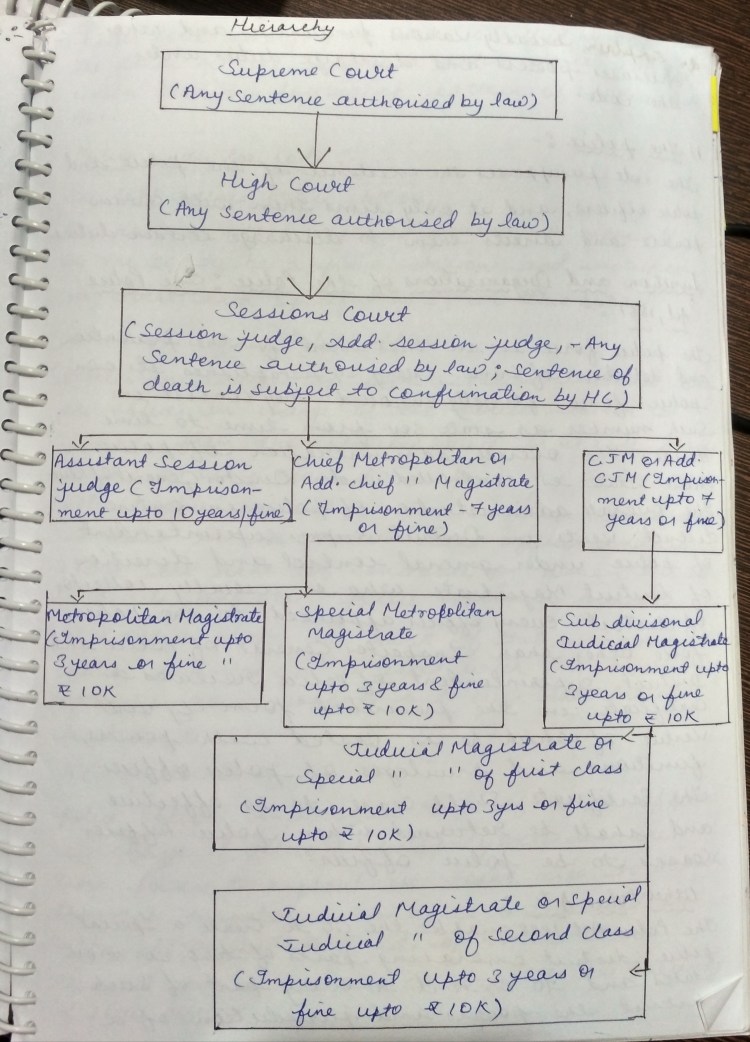
A Judicial Magistrate is that judicial officer of a state who handle(s) minor cases in the specific area comprises of towns, sub-districts, districts, etc. and have limited Judicial powers. Before the pre-independence period Warren Hasting introduced two courts in 1772 namely Diwani Adalat which deals with all civil matters in a district and this court were presided by Collector and the other one is Faujdari Adalat which deals with all type of criminals matters where it was presided by Kazi or Mufti along with 2 maulvis and collector had direct control over this court. But after the enactment of the Indian Constitution it laid down the current legal framework of the legal system and the current Judicial System derives its powers from it.
Now moving forward towards the appointment of Judicial Magistrate and Civil Judge Junior Division in civil and criminals courts. Article 234 of the Indian Constitution talks about appointing authority. The bare reading of Art. 234 is as follows;
‘Appointments of persons other than district judges to the judicial service of a State shall be made by the Governor of the State in accordance with rules made by him in that behalf after consultation with the State Public Service Commission and with the High Court exercising jurisdiction in relation to such State.’
Therefore the Law Commission or State Public Service Commission holds examinations for the appointment of Judicial Magistrate and Civil Judge Junior Division in three-tier i.e. Preliminary round, Mains or theoretical round, and the last one is interview round. Any fresh law graduate between the age of 22-35 years is deemed to be eligible to hold the capacity. A candidate who qualifies this examination will preside as a Judicial Magistrates in Criminal court and Civil Judge Junior Division in civil court.
Further, the Code of Criminal Procedure provides the constitution of criminal courts in chapter Chapter II where Sec. 11,12,13 talks about courts of Judicial Magistrate.
Sec 11 of CrPC:-
It states that in every district other than metropolitan area there shall be established as many Courts of Judicial Magistrates of the first class and of the second class as the State Government may, after consultation with the High Court and establish, for any local area, one or more Special Courts of Judicial Magistrates of the first class or of the second class to try any particular case and where any such Special Court is established, no other Court of Magistrate in the local area shall have jurisdiction to try the case of which such Special Court of Judicial Magistrate has been established. The presiding officers of such Courts shall be appointed by the High Court.
Sec 12 of CrPC:-
In every district other than the metropolitan area, the High Court shall appoint a Judicial Magistrate of the first class to be the Chief Judicial Magistrate, any Judicial Magistrate of the first class to be an Additional Chief Judicial Magistrate, and such Magistrate shall have all or any of the powers of a Chief Judicial Magistrate.
Sec 13 of CrPC:-
The High Court may, on request of Central or State Government confer upon any person who holds or has held any post under the Government, all or any of the powers conferred on a Judicial Magistrate of the first class or of the second class, in respect to particular cases in any local area, not being a metropolitan area and they shall be appointed for a term, not exceeding one year.
Thus by the abovementioned sec. we saw that powers to appoint Judicial Magistrates is distinctive in nature and the power vests with the Higher Courts and the Governments of the respective States. The Code of Criminal Procedure, 1973 provides for the appointment of different magistrates in different states, the step by step procedure for an appointment may vary from state to state depending upon the policies of such State Governments. Every State has made rules for the recruitment of Judicial Magistrate and Civil Judge Junior Division to the State Judicial Service. Consistent with the constitutional provision, most of the States have in their respective rules for the subordinate judiciary, conferred power on the State Public Service Commission to select and recommend candidates for posts in the subordinate judiciary where the recruitment is from the market.
There is some lacuna regarding the examination of PCS(J) and the major one is that this examination is not certain and inconsistent, PCS(J) exam is held quite irregularly, including the announcement of its result that makes it difficult for students to pursue their career in the judiciary. If centre, in reality, wants to decrease the no. of pendency of cases it must urge the state to hold examination every year because the pendency of cases is not a single State problem.
If the judgment skills of only Judges are important to provide Justice then it would be ‘Justice to all(whosoever approaches the court of law)’. Similarly, everybody deserves justice and prima facie its duty of every single person to do justice in every day to day transaction. In the late September 2017, three persons, Registrar (Recruitment) Balwinder Sharma and two beneficiaries Sunita and Sushila, were booked by the police in the Haryana Civil Services (Judicial) paper leak case. The high court full bench comprising justice Rajesh Bindal, justice Rajan Gupta and justice GS Sandhawalia also ordered a suspension of Dr. Balwinder Kumar Sharma and found him liable under Sec 8 (taking gratification, in order, by corrupt or illegal means, to influence public servant), 9 (taking gratification, for the exercise of personal influence with public servant) and 13(1)D (criminal misconduct by a public servant) of the Prevention of Corruption Act,1988. To stop paper leak incidents in the future, the State Public Service Commission may stop printing question papers at their end and instead send paper CDs to the exam centers, just an hour before the exam.

The aforesaid picture was published by outlook in one of its magazines as a cover story.
Deputation in the base of Judicial System is eternally a deed of great and valuable responsibility. The engagement of deputation has been comprehensively commissioned to State Public Service Commission.
Quoting the wordings of William Penny, “to delay Justice is injustice”, and by drawing a conclusion from this statement the main task is to make the deputation of Judges free from all the irregularities. As the base of Judicial System is mainly implanted by the Civil court(s) and Magistrate court(s), and hence to reduce the pendency of cases the appointment should be regular.
Lower Courts are mainly established to exercise the original jurisdiction and the rest of the court(s) (i.e. Hon’ble Supreme Court, Hon’ble High Court(s)) are established mainly for entertaining the appellate jurisdiction(s) but several original jurisdictions has been delegated to these courts by several Constitutional and statutory provisions.
The shortage of Judicial Officers clasps the major contention for the delay in Justice delivery.
By taking reference from three judges case (i.e. S.P. Gupta v The President, AIR 1982 SC 149, SC Advocate-on-record v Union of India, In re Presidential Reference, AIR 1999 SC 1), it can be taken into consideration that the duty of appointment of Judicial officers should be delegated upon the High Courts. As several High Court(s) like Madhya Pradesh High Court is responsible for the appointment of Judicial officers in Lower Judiciary and it can be witnessed over there that the deputation is regular compare to other states where public service commission is responsible for the said task.
Why judiciary, why reforms or dilemmas of this organ is so important?
We have suffered and witnessed the colonial rule and their suppressing legislations. Now as we have attained freedom, its the Constitution which secures our freedom, our right, our liberty, etc. The Supreme Court is known as the interpreter and watchdog of our constitution but on the other hand, its the lower judiciary which provides justice to a tremendous percentage of the population for whom approaching the Supreme Court costs them fortune (that’s altogether a different topic for discussion). The impartiality and commitment to a job are what is required. Uniformity and the Supreme Court’s supervision could be the solution for time being.
Indeed the post holds some expectations with it but it can only be justified by one who holds it.
(Co-authored by Deeba Faryal, Atul Verma and Shivang Jain)
 Deeba's blog